Every time you wrap yourself in a plush bathrobe, lay your head on crisp bed linen, or dry your hands on a well-crafted kitchen towel, you are experiencing the result of a carefully engineered manufacturing journey. Behind every quality textile product lies a disciplined factory process — one that blends precision engineering, skilled craftsmanship, and strict quality assurance to deliver products that perform beautifully and last for years.
In this blog, we take you inside the world of textile manufacturing to explore how some of the most essential home and hospitality products — from bed linen and bath towels to table cloths and kitchen linens — are made to the highest standards.
Stage 1: Raw Material Selection — The Foundation of Quality
Quality begins long before the first thread is spun. The process starts with the careful sourcing of raw materials — predominantly cotton, though blends with polyester, linen, bamboo, or microfibre are also used depending on the product type.
Key considerations at this stage include:
- Cotton grade and staple length — longer fibres (such as Egyptian or Pima cotton) produce softer, more durable fabrics.
- Moisture content and cleanliness of raw fibre — impurities at this stage can compromise the final product.
- Supplier certifications — reputable manufacturers source from suppliers certified under OEKO-TEX®, BCI (Better Cotton Initiative), or GOTS (Global Organic Textile Standard).
Only fibres that pass quality inspection proceed to the next stage. This rigorous selection ensures that every finished product — whether a bath mat or a napkin — has an excellent base.
Stage 2: Spinning and Yarn Production
Raw fibre is cleaned, carded (combed to align fibres), and then spun into yarn. The thickness and twist of the yarn determines the texture and strength of the final fabric. Ring-spun yarns, for instance, are known for their superior softness and are widely used in premium towels, bed linen, and bathrobes. Open-end spinning produces a coarser yarn more suited to heavy-duty products such as oven cloths and service cloths.
Yarn is then wound onto cones and inspected for consistency of thickness (count), twist level, and tensile strength. Any irregularities are identified and corrected before the yarn moves to the weaving or knitting floor.
Stage 3: Weaving, Knitting & Fabric Construction
Different products require different fabric construction methods. This is where manufacturing becomes both a science and an art form.
Bed Linen
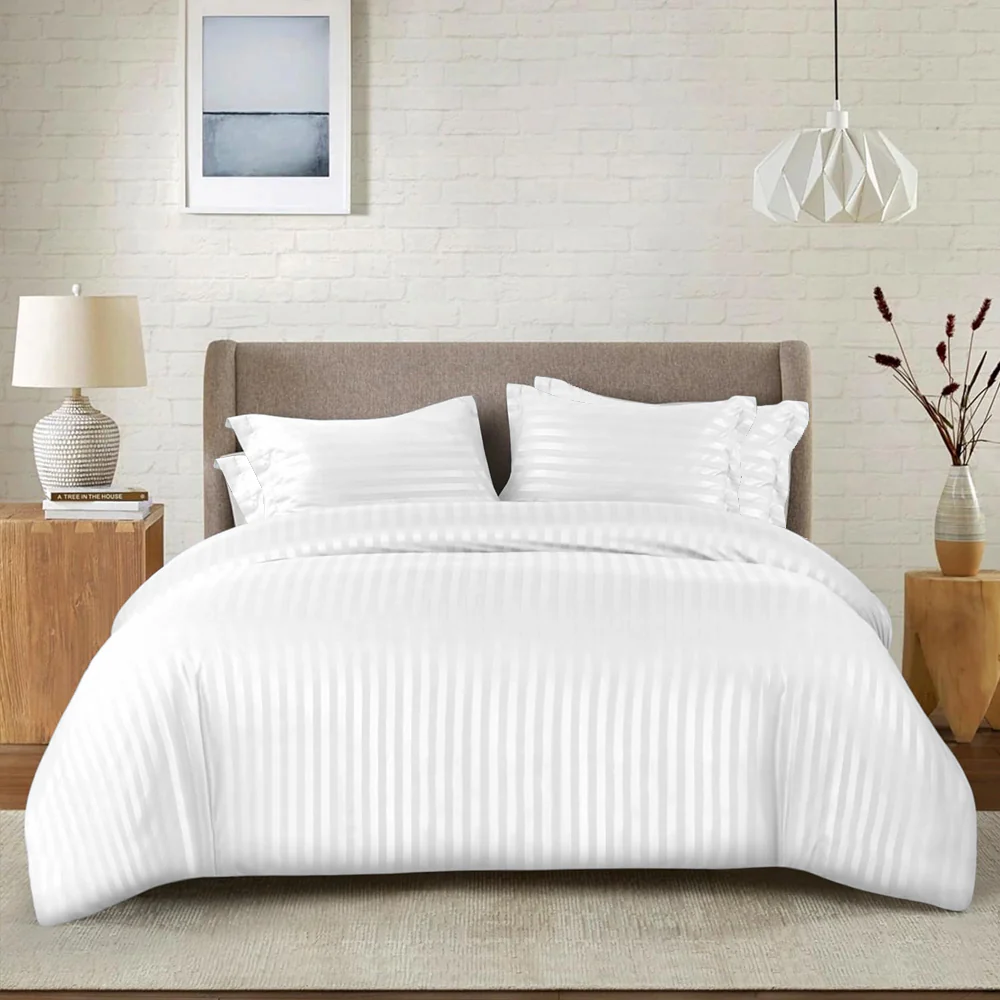
Bed linen — including duvet covers, pillowcases, flat sheets, and fitted sheets — is typically woven on high-speed looms using a percale or sateen weave. Percale (a tight plain weave) produces a cool, crisp feel ideal for hotel bedding, while sateen (a 4-over-1 weave) creates a smoother, lustrous finish preferred in luxury residential linen. Thread count is carefully monitored: reputable manufacturers aim for balanced thread counts (200–600 TC) using quality yarns rather than inflating numbers with multi-ply threads.
Bath Linen, Towels, Face Cloths & Bathrobes
Terry cloth construction is the hallmark of bath linen. Towels, face cloths, hand towels, and bathrobes are woven on specialized terry looms that create the characteristic looped pile on both sides of the fabric. The density of loops (measured in GSM — grams per square metre) directly determines absorbency and plushness. Premium bath towels typically range between 500–700 GSM. Bathrobes are sewn from pre-woven terry fabric, with reinforced seams, double-stitched collars, and securely attached belt loops to ensure long-term durability.
Bath Mats
Bath mats require a heavier construction — typically 800–1,200 GSM — to provide the cushioning and water absorption needed for wet environments. Many quality bath mats feature a latex or non-slip backing applied during finishing, ensuring safety without compromising softness. Yarn-dyed bath mats go through additional colour-setting processes to ensure vibrant, long-lasting colours.
Table Linen, Table Cloths & Napkins
Table linen is constructed from tightly woven fabrics — often damask, twill, or plain weave — that offer stain resistance and a refined aesthetic. Damask table cloths, with their reversible jacquard patterns, are woven on computerized looms capable of producing intricate floral or geometric designs within the fabric itself. Napkins are cut to precise dimensions, hemmed with mitred corners, and often embroidered or monogrammed for hospitality clients requiring branded presentation.
Kitchen Linens: Kitchen Towels, Oven Cloths & Service Cloths
Kitchen textiles demand durability above all else. Kitchen towels are typically woven from cotton or cotton-linen blends in a waffle or huck-a-back weave, both of which enhance moisture absorption and drying efficiency. Oven cloths are constructed with multiple fabric layers and heat-resistant materials to protect against temperatures encountered in professional catering environments. Service cloths — used extensively in hotels and restaurants — are made from heavy-duty cotton twill, often with coloured border stripes to denote specific uses in commercial kitchens.
Stage 4: Dyeing and Finishing
Once fabric is constructed, it moves through a series of wet and dry finishing processes that transform a grey (undyed) cloth into a finished product ready for use.
- Scouring and Bleaching: The fabric is washed thoroughly to remove natural waxes and impurities, then bleached to achieve a clean base colour.
- Dyeing: Reactive dyes are most commonly used for cotton-based textiles as they form a strong chemical bond with the fibre, resulting in excellent colourfastness — crucial for products washed repeatedly at high temperatures. Vat dyes are used for deep shades requiring outstanding wash and light fastness.
- Softening: Fabric softeners are applied during a final rinse to enhance the hand-feel — particularly important for towels and bathrobes.
- Calendering and Pressing: For bed and table linen, calendering (passing fabric through heated rollers) creates a smooth, wrinkle-free surface and adds a subtle sheen.
- Anti-microbial and Stain-Resistant Treatments: Many commercial-grade products — particularly for healthcare and hospitality — undergo additional treatment to inhibit bacterial growth and resist staining.
Stage 5: Cutting, Sewing & Garment Construction
Finished fabric rolls are transferred to the cutting room, where computer-aided design (CAD) systems generate precise cutting patterns to minimise fabric waste. Each product type — be it a bathrobe, a duvet cover, or a tablecloth — has exact dimensions and tolerance specifications. Industrial sewing machines then assemble the cut panels. Seam types vary by product: flat-locked seams for towels and mats, French seams for high-end bed linen, and overlocked edges for napkins and cloths. Skilled machinists and line supervisors inspect each unit at this stage for seam integrity, stitch density, and dimensional accuracy.
Stage 6: Quality Control & Testing
Quality assurance is not a single checkpoint — it is embedded throughout the entire production process. Reputable manufacturers operate under internationally recognised quality management systems (such as ISO 9001) and conduct a battery of product tests before any item is approved for dispatch.
Common quality tests include:
- Colourfastness testing — wash, rub, and light fastness tested to ISO and AATCC standards.
- Shrinkage testing — samples are washed multiple times at defined temperatures to verify dimensional stability.
- Pilling and abrasion resistance — critical for bed linen and bathrobes subjected to frequent laundering.
- Absorbency testing — particularly vital for towels, face cloths, and bath mats.
- Tensile and tear strength — ensuring seams and fabric can withstand commercial laundering stress.
- pH testing — to confirm the fabric is skin-safe and free of harmful chemical residues.
Products that fail any test are quarantined, assessed, and either reworked or rejected. Only items meeting full specification are approved for packaging and despatch.
Stage 7: Packing, Labelling & Despatch
Approved products are neatly folded, labelled with care instructions, size markings, and composition details, then packed according to customer specifications. Bulk wholesale orders are typically palletised and shrink-wrapped for transport. For hotel and hospitality contracts, items may be banded, boxed, or individually poly-bagged. A final inspection of each packed consignment is conducted against the order specification before it leaves the warehouse.
Sustainability in Modern Textile Manufacturing
The modern textile industry is increasingly conscious of its environmental footprint. Leading manufacturers have invested in closed-loop water recycling systems, energy-efficient dyeing technologies, and responsible chemical management programmes. Certifications such as OEKO-TEX® STANDARD 100, GOTS, and Bluesign® signal a manufacturer’s commitment to producing textiles that are safe for people and the planet. These considerations are now a key purchasing criterion for buyers across the retail, healthcare, and hospitality sectors.
Bringing Quality Products to the UK Market
The journey from raw fibre to finished product is long, exacting, and demanding — but the result is a range of textiles that stand the test of time. Whether it is a crisp damask tablecloth gracing a fine dining restaurant, a plush terry bathrobe hung in a luxury hotel suite, or a heavy-duty service cloth working hard in a busy commercial kitchen, quality-manufactured textiles make a tangible difference to every user’s experience.
For businesses seeking to source these products in the UK, working with a trusted wholesale supplier is essential to accessing factory-quality textiles at competitive prices. TH Mills is a leading UK-based wholesale supplier of premium home and hospitality textiles, offering an extensive range including bed linen, bath linen, bathrobes, bath mats, face cloths, towels, slippers, table linen, table cloths, napkins, kitchen linens, kitchen towels, oven cloths, and service cloths. With a reputation built on consistent quality, reliable supply, and competitive wholesale pricing, TH Mills serves retailers, hotels, healthcare providers, and catering businesses across the United Kingdom — making factory-quality textiles accessible to businesses of every size.